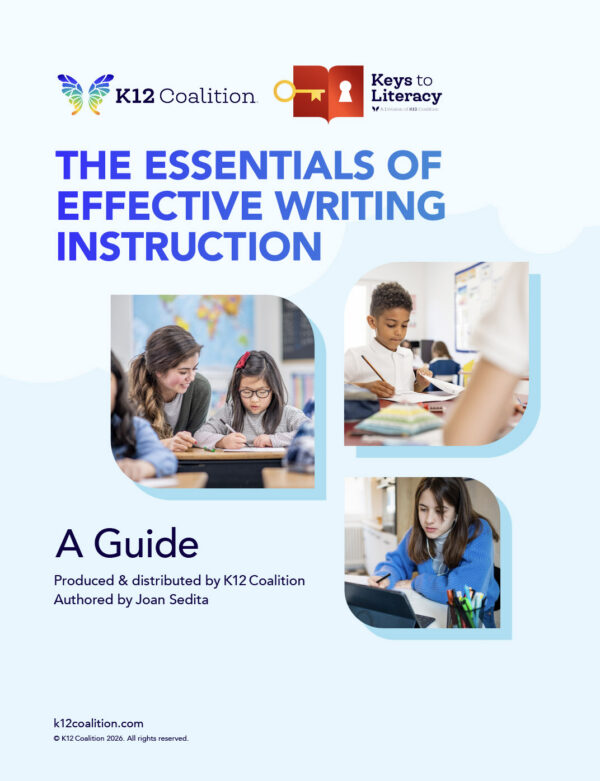

















The Essentials of Effective Writing Instruction
Writing is more than a way for students to demonstrate what they have learned. It is a powerful tool for developing ideas, strengthening comprehension, communicating clearly, and thinking critically across every subject.
Yet writing often receives less instructional attention than reading. Many educators also report receiving limited preparation for teaching writing effectively. As a result, students may be asked to write without receiving the explicit instruction, modeling, practice, and feedback they need to become confident, proficient writers.
The Essentials of Effective Writing Instruction, authored by Joan Sedita and produced by K12 Coalition, provides educators with a practical, research-based overview of the skills and instructional practices that support writing development from kindergarten through grade 12.
Understanding the Components of Skilled Writing
At the center of the guide is The Writing Rope, an instructional framework developed by Joan Sedita. Much like a rope is created by weaving individual strands together, skilled writing requires students to integrate several interconnected areas of knowledge and ability.
The five strands of The Writing Rope are:
Critical Thinking
Students must be able to generate ideas, gather and organize information, take notes, summarize sources, and move through the stages of the writing process. Writing also helps students process information and deepen their understanding of what they read and learn.
Syntax
Sentences are the building blocks of written communication. Syntax instruction helps students understand grammar, sentence structure, punctuation, and the ways words, phrases, and clauses can be arranged to communicate meaning clearly.
Text Structure
Students need explicit instruction in how different types of writing are organized. This includes narrative, informational, and opinion or argument writing, as well as paragraph structure, patterns of organization, and the use of linking and transition words.
Writing Craft
Writing craft includes the choices that make writing clear, engaging, and appropriate for the situation. Students learn to consider word choice, voice, literary devices, and the task, audience, and purpose of a writing assignment.
Transcription
Foundational skills such as spelling, handwriting, and keyboarding allow students to translate their ideas into written language. When these skills become more automatic, students have more mental capacity available for planning, organizing, and developing their ideas.
The Writing Rope is not a prescribed curriculum or a sequence of isolated skills. Instead, it gives educators a way to examine whether writing instruction addresses all the essential components students need. The strands should develop together, with instruction becoming increasingly sophisticated as students advance through the grades.
Writing Instruction Must Be Explicit
Simply assigning more writing is not enough. Students improve when educators explicitly teach the strategies, structures, and processes that skilled writers use.
Effective explicit instruction includes:
- Clearly explaining the skill or strategy
- Modeling how to use it through examples and teacher think-alouds
- Providing guided practice and corrective feedback
- Gradually releasing responsibility to students
- Giving students opportunities to apply the skill independently
This gradual-release approach is often described as “I do, we do, you do.” The teacher first demonstrates the skill, students then practice it with support, and eventually they apply it independently.
The guide also emphasizes differentiated instruction, scaffolding, collaboration, mentor texts, and frequent opportunities to write across subject areas. These practices make writing more accessible while still allowing students to take ownership of the work.
Connecting Reading and Writing
Reading and writing are sometimes taught as separate parts of the curriculum, but they draw on many of the same skills and cognitive processes.
When students write about what they read, they must identify important information, organize their thinking, make connections, explain ideas, and support conclusions. These activities can strengthen reading comprehension and content knowledge.
Writing instruction can also support reading development. Teaching sentence structure, spelling, text organization, paragraph development, and summarization equips students with tools to make sense of increasingly complex texts.
Integrating reading and writing instruction therefore gives educators an efficient and meaningful way to strengthen literacy while deepening learning across the curriculum.
Teaching the Writing Process
Many students approach writing as a single task: begin writing and stop when the draft is finished. Skilled writers, however, move through a flexible process of thinking, planning, drafting, reviewing, and improving their work.
The guide introduces the Process Writing Routine:
- Think: Identify the audience and purpose, brainstorm ideas, gather information, and take notes.
- Plan: Organize ideas and use a planning guide or outline.
- Write: Translate the plan into sentences and paragraphs.
- Revise: Review the content, proofread conventions, and rewrite as needed.
These stages are recursive rather than strictly linear. A writer may return to the thinking stage while drafting, revise a plan after discovering a stronger organizational approach, or gather additional information while reviewing a draft.
Using a consistent routine and shared instructional language across subjects helps students internalize the process and become more independent writers.
Building Strong Sentences and Paragraphs
Effective writing instruction must focus on sentences and paragraphs.
Sentence instruction begins with foundational concepts, such as recognizing complete sentences and fragments. As students progress, they learn to elaborate sentences, combine ideas, use increasingly sophisticated grammar, and make purposeful choices about structure and punctuation.
Two especially useful instructional activities are sentence combining and sentence deconstruction. Sentence combining asks students to merge shorter sentences into a clear, grammatically correct sentence. Sentence deconstruction asks them to break a complex sentence into smaller parts to uncover its meaning.
Paragraph instruction should address:
- Identifying and expressing a main idea
- Writing topic sentences
- Developing ideas with relevant supporting details
- Using concluding sentences when appropriate
- Organizing information logically
- Connecting sentences with transitions
- Maintaining cohesion throughout the paragraph
These skills remain important well beyond the elementary grades. Older students must write paragraphs that explain, compare, analyze, synthesize, and defend increasingly complex ideas.
Teaching Students to Recognize Text Structure
Students benefit from learning how different types of writing work. Informational writing explains or presents information. Opinion and argument writing aims to convince the reader through claims, reasons, and evidence. Narrative writing tells a real or imagined story through events and literary elements.
Within these larger text types, writers use common patterns of organization, including:
- Description and explanation
- Sequence and chronology
- Cause and effect
- Compare and contrast
- Problem and solution
When educators explicitly teach these patterns, students become better able to organize their own writing and recognize how ideas are structured in the texts they read.
Transition words and phrases also play an important role. They connect ideas, guide the reader, and signal relationships such as sequence, contrast, cause, or comparison.
Considering Task, Audience, and Purpose
Skilled writers make decisions based on what they are being asked to write, who will read it, and what the writing is intended to accomplish.
The guide encourages educators to teach students to consider:
- Task: What am I being asked to do, and what form should the writing take?
- Audience: Who will read this piece, and what does that reader need to know?
- Purpose: Am I writing to inform, explain, convince, analyze, or tell a story?
These considerations affect tone, word choice, supporting information, level of detail, organization, and style.
Teachers can support students by making writing assignments clear and specific. Providing expectations for the task, audience, purpose, length, requirements, and available supports reduces unnecessary confusion and allows students to focus on the writing itself.
Supporting Executive Functions
Writing places significant demands on attention, memory, organization, planning, self-monitoring, and cognitive flexibility. Students must often manage all of these processes while also remembering spelling, grammar, sentence structure, content, and assignment expectations.
Students who struggle with executive functioning may benefit from supports such as:
- Graphic organizers
- Planning guides
- Word banks
- Checklists
- Models and mentor texts
- Clearly defined steps
- Visual reminders
- Opportunities to set and monitor goals
These supports are not intended to complete the work for students. They reduce unnecessary cognitive demands, allowing students to focus on learning and applying writing strategies more independently.
Creating a Stronger Approach to Writing Instruction
Effective writing instruction does not depend on one isolated program, lesson, or classroom. It requires a coordinated approach that develops essential skills across grade levels and reinforces writing throughout the school day.
Teachers can use The Writing Rope to reflect on their current instruction, identify areas that may need more attention, and select strategies that meet their students’ needs. Administrators and instructional leaders can use the framework to evaluate curriculum alignment, professional learning priorities, and the consistency of writing instruction across classrooms and grades.
When students receive explicit instruction, meaningful practice, useful feedback, and regular opportunities to write, they become better prepared to communicate their ideas and demonstrate what they know.
Writing remains an essential skill for academic achievement, future careers, civic participation, and everyday life. Even as technology and artificial intelligence continue to change how people create and communicate, students still need the ability to think deeply, organize ideas, evaluate information, and express themselves clearly.
That is why effective writing instruction is not becoming less important. It is becoming more essential than ever.