
















America Has a Math Problem. Here’s How We Solve It.
More than half of American students are not proficient in math. Only 39% of fourth graders and 28% of eighth graders scored at grade level in 2024 — numbers that have been declining for years, with the pandemic accelerating that slide to its lowest point in two decades. For students from low-income backgrounds, students of color, English learners, and students with disabilities, the gaps are even more stark.
The frustrating part? We already know what works. The problem isn’t a lack of research — it’s a lack of consistent, systemwide implementation.
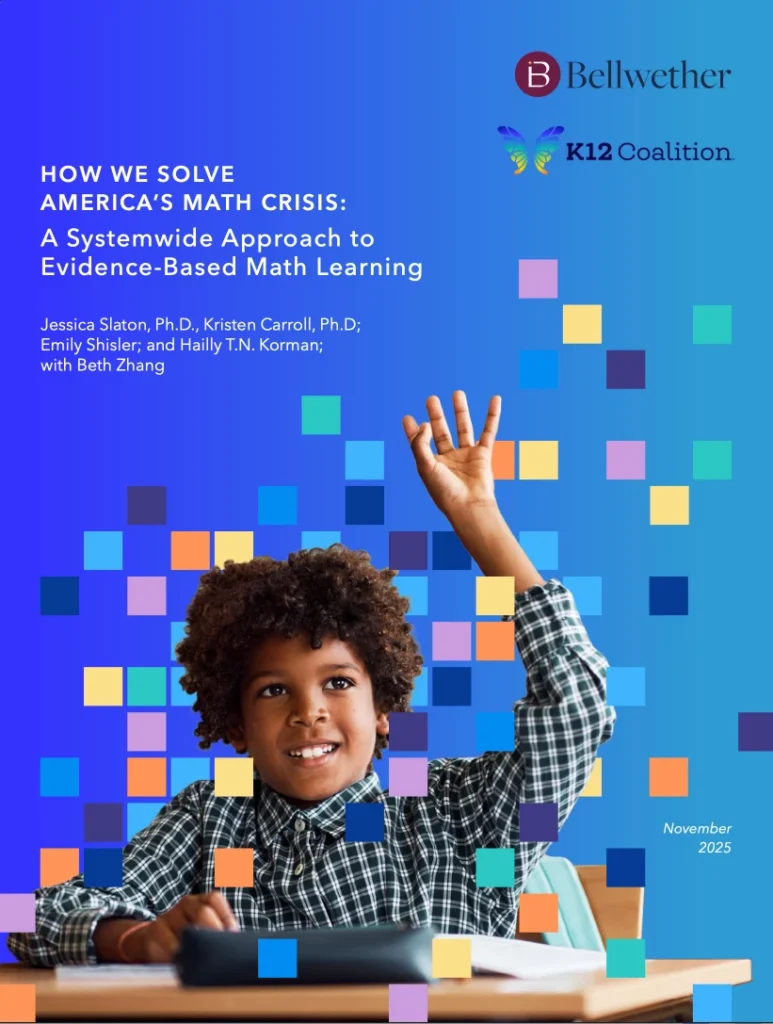
That’s the central argument of How We Solve America’s Math Crisis: A Systemwide Approach to Evidence-Based Math Learning, a new report from K12 Coalition and Bellwether authored by researchers Jessica Slaton, Ph.D., Kristen Carroll, Ph.D., Emily Shisler, Hailly T.N. Korman, and Beth Zhang. It’s a timely, practical, and sobering read for anyone working in or around K-12 education — and it comes with a clear road map forward.
Why Math Matters More Than Ever
The report makes a compelling case that math proficiency isn’t just an academic milestone — it’s an economic one. Research cited in the report found that raising math scores by age 12 is associated with meaningfully higher earnings at age 30, outpacing comparable gains in reading. By 2031, nearly 85% of all new jobs in the U.S. will require some form of postsecondary education, and math-intensive careers — from data science to AI development — are among the highest paying.
When students fall behind in math early, the consequences compound. Gaps in elementary skills like number sense and fractions make middle school algebra harder, which limits access to advanced high school coursework, which narrows college and career pathways. Students placed into remedial math in college — which doesn’t count toward a degree — complete their degrees at rates below 20%. The pipeline narrows fast, and it narrows early.
Three Pillars of Effective Math Instruction
The report organizes evidence-based math instruction around three core goals that work together rather than in isolation.
The first is building math identity — in both students and educators. Too many learners internalize the belief that they are simply “not math people,” a mindset often reinforced by teaching that prioritizes speed and correctness over reasoning and understanding. When classrooms foster growth mindsets, encourage productive struggle, and make space for collaborative problem-solving, students begin to see themselves as capable mathematical thinkers. The report emphasizes that this isn’t just a student issue — teachers’ own relationship with math shapes how they teach it, often in ways they don’t realize.
The second pillar is balancing conceptual understanding with procedural fluency. For too long, math education has swung between extremes — either drilling procedures without meaning or pursuing conceptual exploration without ensuring students can execute basic computations reliably. The research is clear that the two develop together and reinforce each other. Students who understand why a method works are more likely to remember it, apply it correctly, and extend it to new problems. The report uses the simple example of “carrying the 1” to illustrate how procedural steps become more durable and flexible when students understand the place value logic behind them.
The third pillar is ensuring that learning progressions are logical and cumulative. Math concepts build on each other in ways that most other subjects don’t. When the sequence is broken — when students miss foundational ideas or are moved forward before gaps are addressed — the effects show up years later. The report traces this through the learning arc of fractions as a clear example of how each stage depends on what came before.
The System Has to Change, Not Just the Classroom
One of the report’s most important contributions is its insistence that classroom-level changes alone are not enough. Decades of well-intentioned reforms — new curricula, updated standards, professional development mandates — have produced inconsistent results because they were implemented in fragmented, disconnected ways.
What’s required instead is a coherent, systemwide commitment. That means leaders establishing a clear shared vision of what high-quality math instruction actually looks like, auditing curricula and assessments to ensure alignment with that vision, and building professional learning systems that sustain the work over time — not just as one-off trainings. It means protecting collaborative planning time for teachers, investing in coaching that goes into classrooms and provides real-time feedback, and using student data consistently and meaningfully to inform instruction.
The report points to K12 Coalition’s Lavinia Group as a concrete example of what this looks like in practice. Schools partnering with Lavinia Group saw average gains of 13 percentage points on state math assessments after just one year, with those gains growing to 15.7 points by year two — and holding across schools regardless of their starting proficiency level.
Who Should Read This Report
This report is essential reading for district leaders and principals who want a research-grounded framework for improving math outcomes at scale. It’s equally valuable for curriculum directors evaluating whether their instructional materials are truly aligned, math coaches and instructional leaders looking for a coherent model to anchor their work, and classroom teachers who want to understand the research behind the practices they’re being asked to implement.
If your school or district is grappling with math achievement — whether you’re starting from a low baseline or trying to sustain gains — this report gives you both the context to understand how we got here and the tools to chart a better path forward.